What Assessment Looks Like

Robust assessment of student learning is faculty-driven, rooted within the context of the discipline and considered an integral part of one’s teaching practice,
While there are multiple approaches to assessment, all are designed to support student learning. Assessment cycles regularly involve:
- identifying a relevant assignment in your course that aligns with a course/program/institutional outcome
- using a shared rubric to evaluate student work
- submitting aggregated data and discussing the results with one’s colleagues to drive continuous improvement.
Assessment in education is the systematic process of gathering, interpreting, and using information to determine how well students are achieving learning outcomes. Unlike grading, which often reflects overall performance or participation, assessment focuses specifically on learning. Thoughtful assessment helps instructors make informed decisions about instruction, identify areas where students need support, and ensure course outcomes are met.
Assessment practices are rooted in the belief that all students should develop a core set of skills, known as Institutional Learning Outcomes (ILOs), regardless of their major. When course-level assessments are aligned with ILOs, faculty can ensure that their teaching supports student success beyond individual assignments. This process also helps departments, as well as the college understand how well programs of study prepare students for future academic, personal, and professional growth. For more information about Institutional Learning Outcomes, visit the KCC assessment website.
Course-level assessment measures how well students achieve the specific outcomes of a course. These outcomes may include critical thinking, quantitative reasoning, or discipline-specific skills such as conducting research or interpreting data. Assessment typically involves regular course assignments such as essays, lab reports, presentations, or portfolios, and provides evidence of student learning that informs teaching.
Assessments can be:
- Formative: Conducted throughout a course to provide feedback and guide instruction (e.g., discussion posts, draft submissions, or in-class activities).
- Summative: Used at the end of a unit or course to evaluate final performance (e.g., final papers, exams, or capstone projects).
Effective course design begins by asking: What should students know or be able to do by the end of this course? The answer to this question are your learning outcomes. Once outcomes are established, assessments can be chosen that provide evidence of whether students are meeting the outcomes. Finally, to assist students in achieving the outcomes, activities are developed that engage students so that they are able to successfully complete the assessments and thereby acheive the learning outcomes.
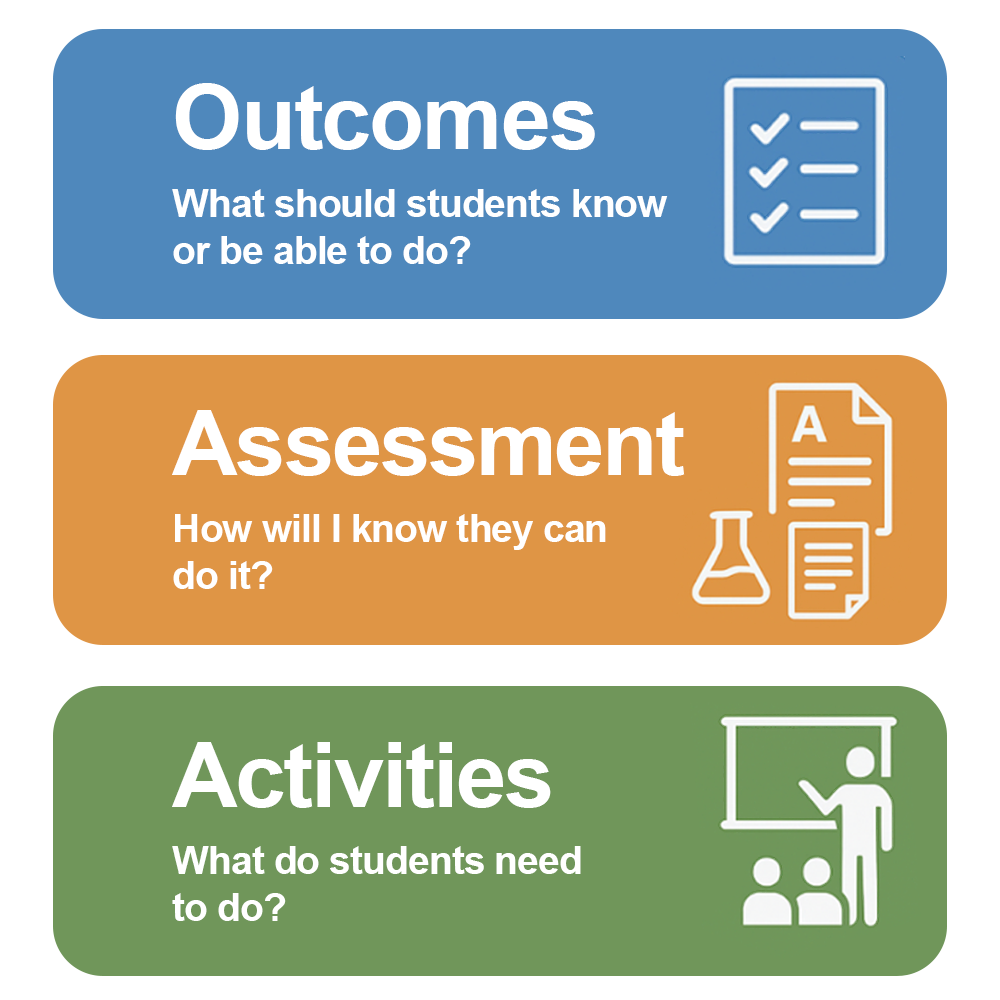
For example, in a public speaking course, if a learning outcome is “Students will be able to deliver a clear and persuasive oral presentation,” activities can include practicing impromptu speaking, analyzing sample speeches, and engaging in peer critique sessions. The assessment would be assigning a final persuasive speech graded with a rubric evaluating clarity, structure, use of evidence, and delivery. Aligning these three elements creates a focused and coherent learning experience.
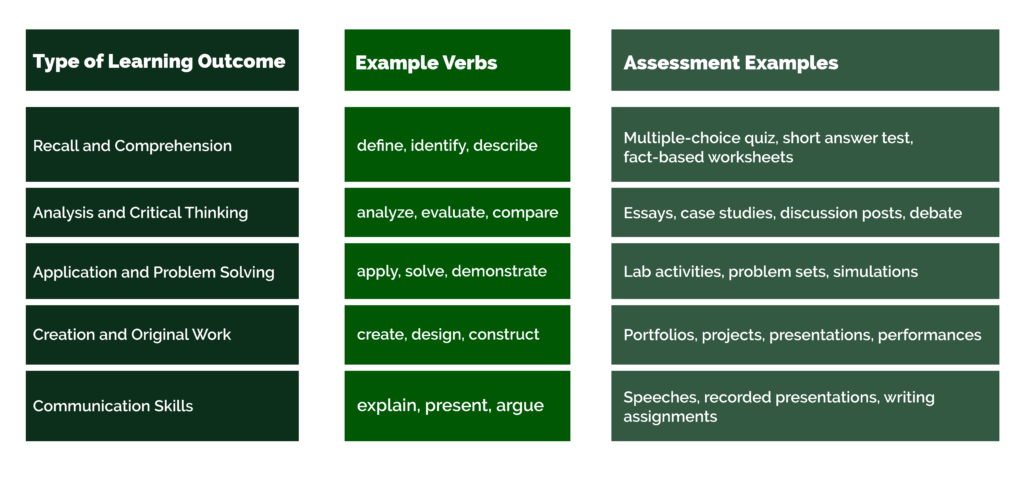
Selecting the right assessment depends on your course outcomes, the skills you want students to demonstrate, and your discipline. Bloom’s Taxonomy is a helpful tool to match assessments with the appropriate level of cognitive demand. Refer to the chart below to identify the cognitive load, associated verb used to write the outcome and example assessment type.
To support you in selecting appropriate assessments, KCeL offers the Meaningful Examples of Assessment by Discipline and Evaluation (MEADE Repository). It serves as an evolving repository of discipline specific, practical, assignments and assessment tools that align with CUNY Pathways outcomes.
Rubrics promote fairness, clarity, and consistency in grading. A rubric outlines criterion for an assignment and describes varying levels of performance. They help students understand expectations and give instructors a structured way to evaluate work and provide feedback.
Rubrics are especially helpful for complex, subjectives assignments used in large classes, across multiple sections. They allow instructors to coordinate and consistently grade student work so that normalized assessment data can be gathered and analyzed.
Sample rubrics for can be viewed in the MEADE Repository These can be adapted to align with your course outcomes or used as-is.
Assessment is most powerful when it leads to course improvement. After reviewing student work, you might consider if there are particular parts of an assignment where students are consistently struggling. Based on this information, you can review your assignment prompt to make sure it is clear. You can aslo think about if there are any gaps in your teaching that need to be addressed.
For example, if students have difficulty synthesizing sources, you might revise the assignment prompt, scaffold the skill with a practice activity, or spend more time on it in class. Small changes based on assessment results can lead to significant improvements in learning.
You don’t have to navigate assessment alone. The Office of Institutional Effectiveness and the Center for e-Learning (KCeL) offer support at every stage of the assessment process. Contact KCeL to book a one-on-one consultation with KCeL’s instructional designer or attend a KCeL sessions on course design, universal design for learning, and effective assessment strategies. You can also view the resources on the MEADE Repository
For questions or support, contact [email protected].

